
 info@globalu.com


Explains how costs are classified and how cost behaviour is represented across business operations.
Follow us on :

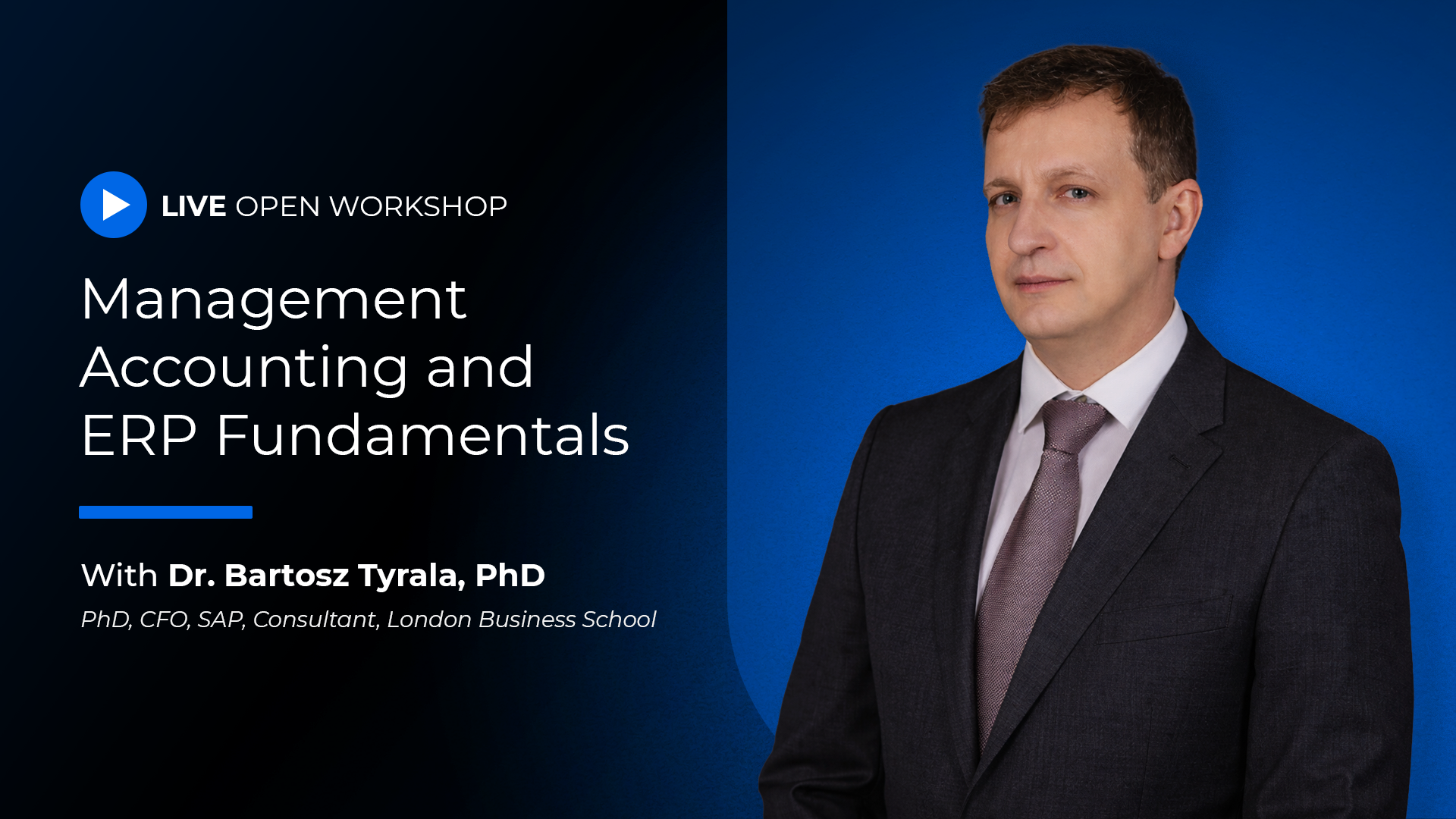
Management Accounting and ERP Fundamentals
This is part of Finance Fundamentals Package

Management Accounting and ERP Fundamentals
This is part of Finance Fundamentals Package
Self - paced Programme Overview
This self - paced programme is part of Finance Fundamentals Package by our expert Bartosz Tyrala. Organisations use management accounting and ERP systems to structure financial information and interpret business performance. This course introduces key management accounting concepts and explains how they are represented within ERP environments. Through clear explanations and practical examples, learners understand how cost structures, financial statements and budgeting concepts are organised and how ERP systems support the representation of financial data in business contexts..
Programme Structure
Key Module 1: Cost Classification and Behavior in Business Operations
Key Module 2: Cost-Volume-Profit Analysis for Strategic Decisions
Introduces cost-volume-profit concepts and explains how relationships between cost, volume and profit are described.
Key Module 3: ERP Systems: Integration and Management Accounting Modules
Explains how ERP systems integrate management accounting concepts and how system modules structure financial data.
Key Module 4: Cost Centers and Profit Centers in ERP
Introduces cost and profit centres and explains how organisational structures are represented within ERP systems.
Key Module 5: Cost and Profitability Management: Actual vs Standard Costing
Explains the difference between actual and standard costing and how profitability concepts are represented in ERP environments.
Key Module 6: Financial Statements in the ERP Context
Explains how financial statements are structured within ERP systems and how financial information is represented.
Key Module 7: Budgeting and Forecasting with ERP Data
Introduces budgeting and forecasting concepts and explains how ERP data supports financial planning structures.
Key Module 8: Capital Investment Evaluation in ERP Environments
Explains how investment evaluation concepts are represented within ERP systems and financial structures.
Key Module 9: Integrated ERP Case Study: Strategic Decision-Making Simulation
Provides a structured overview of how accounting and ERP concepts are combined in a comprehensive business context.
Business Outcomes
Learners understand the core concepts of management accounting and how they are represented within ERP systems. They recognise how cost structures, financial statements and budgeting concepts are organised and can explain how ERP systems structure financial information in business contexts.
Is this right for your organisation?
Suitable for organisations introducing teams to management accounting concepts in ERP environments. Relevant for professionals in finance, operations or management roles who need to understand accounting terminology and how ERP systems represent financial data.
Programme Impact
The course creates a shared understanding of management accounting and ERP terminology across teams. This supports clearer communication and more consistent interpretation of financial information within organisations.